An ERP is not software you buy: it is how your business already works
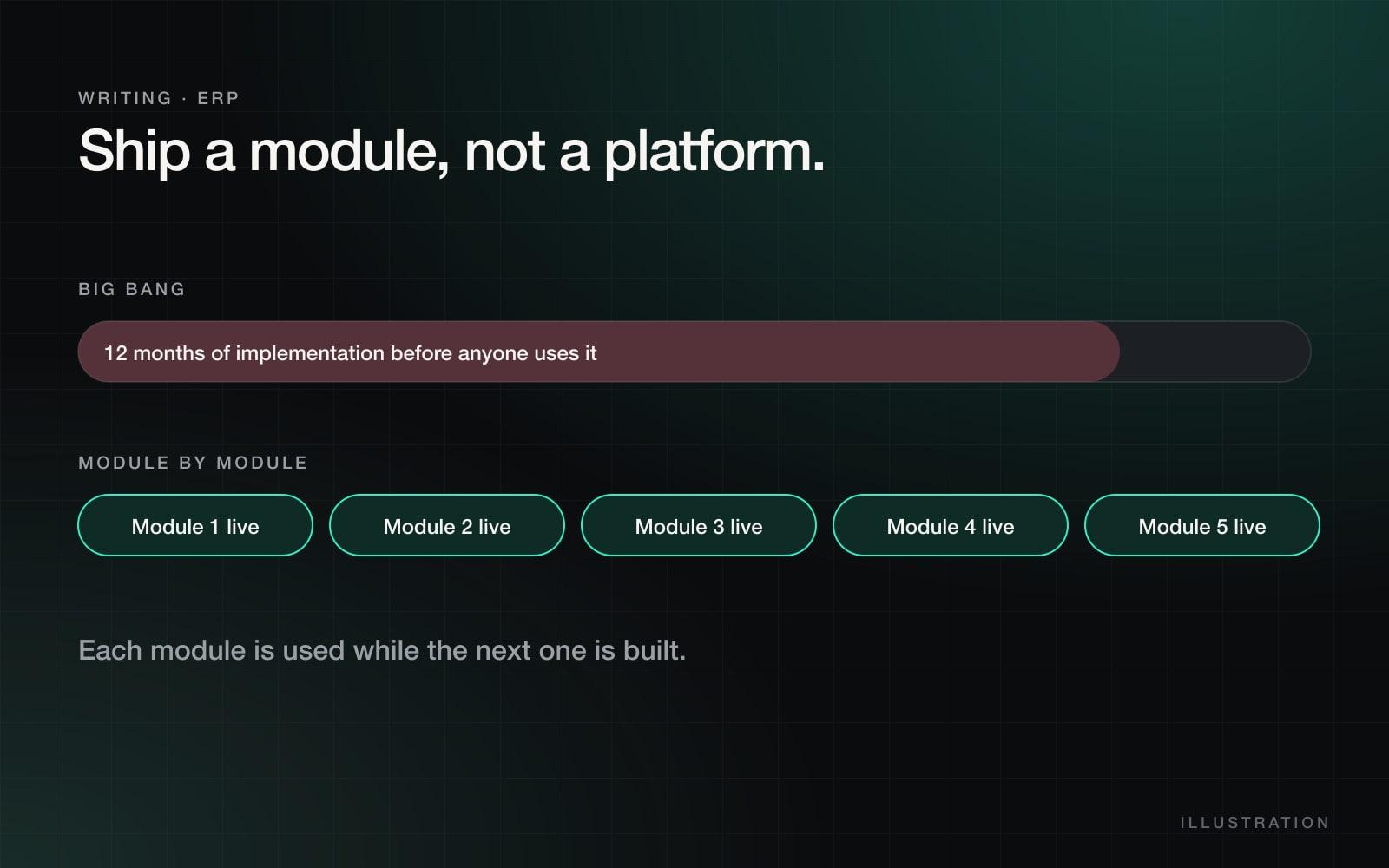
Mid-sized businesses usually meet ERP the same way. A long evaluation. A large licence. A twelve-month implementation. And then, eighteen months later, a system used for about a third of what it was bought for, with the spreadsheets quietly still running alongside it.
The failure is rarely the software. It is the assumption that a business will reshape itself around a product.
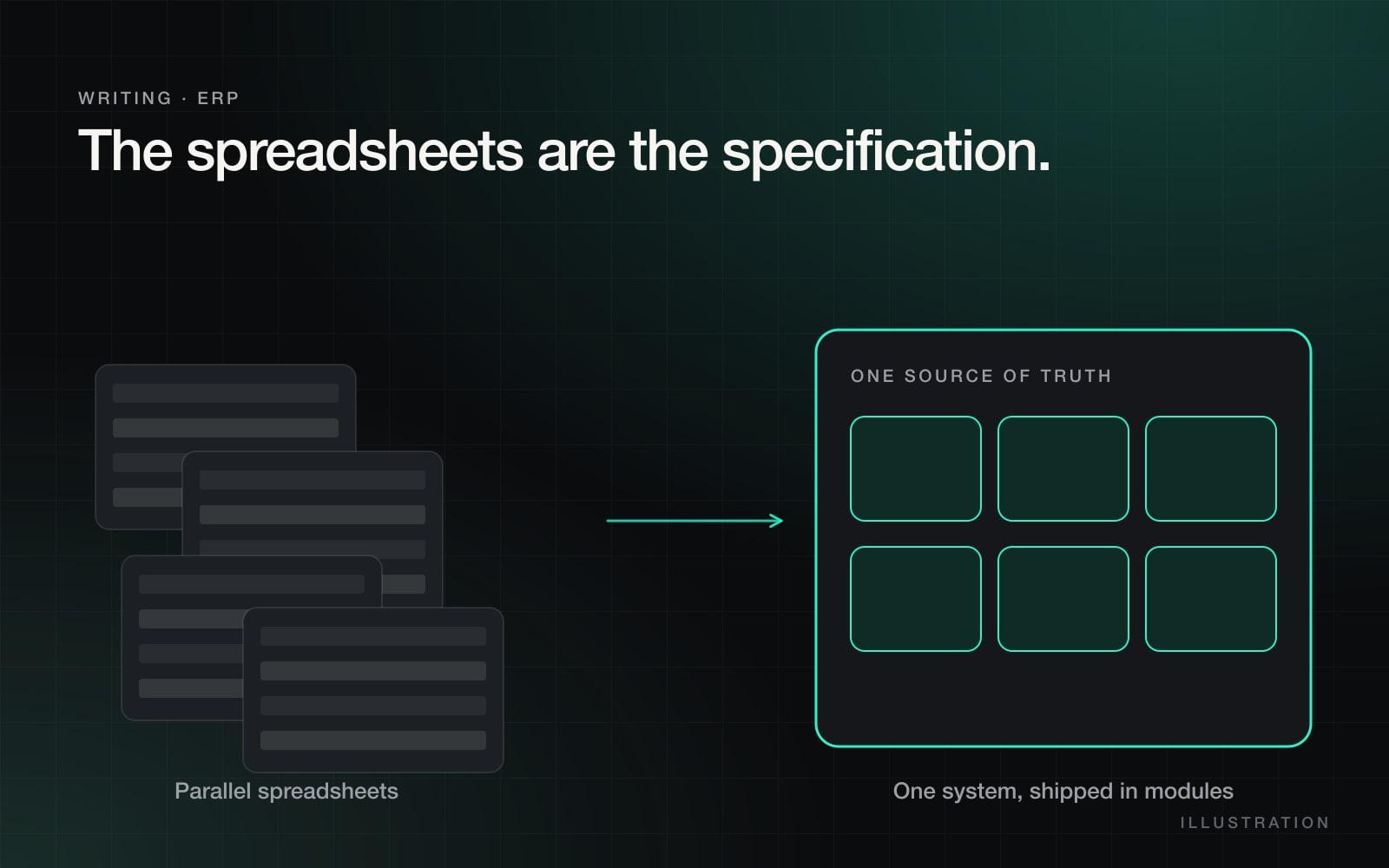
The spreadsheets are the specification
Walk into any company that is outgrowing its systems and count the parallel spreadsheets. Every one of them is a small, accurate description of a process the official system does not handle.
They are not a mess to be cleaned up. They are free requirements documentation, written by the people who actually do the work, maintained daily, and validated by the fact that the business depends on them.
Before replacing them, read them. The structure of someone's spreadsheet tells you what they actually need to see, in what order, and which fields they gave up on filling in.
Why packaged ERP stalls here
Off-the-shelf works well in two situations: your processes are genuinely standard, or you are willing to change them to match the product. Large enterprises can afford the second option, they have change-management teams whose job it is.
A mid-sized business usually has one or two processes that are genuinely theirs. Often it is the thing they are good at: the way they handle a particular kind of order, a pricing rule that reflects fifteen years of knowing their customers, a quality step nobody else bothers with.
That is exactly where packaged systems force expensive customisation, and customisation in a packaged ERP is the worst of both worlds. You pay enterprise licence fees and you maintain bespoke code, with an upgrade path that breaks it.
Custom makes sense when the fit matters more than the feature list. It is not a cheaper option, and anyone selling it as one is lying. It is a better fitting option, which is a different argument.
Ship a module, not a platform
A 17-module system does not get built by designing 17 modules. It gets built by shipping one narrow module into real use, fixing what people complain about, then doing the next one.
The sequence that works:
- Map one department as it really runs. Not the process document, the actual work, spreadsheets included.
- Build the narrowest thing that removes the worst manual step. Resist every request to add scope at this stage.
- Put it in front of real users within weeks. Not a demo. Real data, real work, with the old spreadsheet still available as a safety net.
- Fix what they complain about. Then, and only then, start the next department.
The compounding benefit is trust. By the fourth module, departments are asking to be next instead of being scheduled. That changes the economics of the whole programme, because adoption stops being something you have to enforce.
Adoption is a design problem, not a training problem
Here is the rule I have never seen broken: if a module takes longer than the spreadsheet it replaces, people will use the spreadsheet.
Not out of stubbornness. Because they have a job to do today.
Which means every screen has to beat the thing it is replacing on the day it launches, not after training, not after the next release, not once everyone gets used to it. If a task took four clicks in a spreadsheet, four clicks is your budget.
Two practical consequences:
- Launch with the data already in it. A system that starts empty does not get used. Migration is part of the module, not a phase afterwards.
- Do not make people enter data they do not benefit from. If a field exists only for a report somebody else reads, either derive it or accept that it will be filled with garbage.
What you are actually buying
Strip away the feature lists and the point of all of it is one sentence: a number means the same thing in two departments.
Everything else follows from that. Approvals can live in the system because there is one record to approve against. Reporting runs on live data because there is only one version of it. Access control matches the org chart because there is a single place to apply it. Cross-department questions get answered by opening a record instead of walking over to ask.
That is the deliverable. Not modules, not dashboards, agreement about what is true.
When off-the-shelf is the right answer
To be fair to the other side: if your processes genuinely are standard, if you have no unusual product or pricing logic, if your reporting needs are ordinary and your team is small enough that one tool can cover everyone, buy the product. Configure it, do not customise it, and spend the saved money elsewhere.
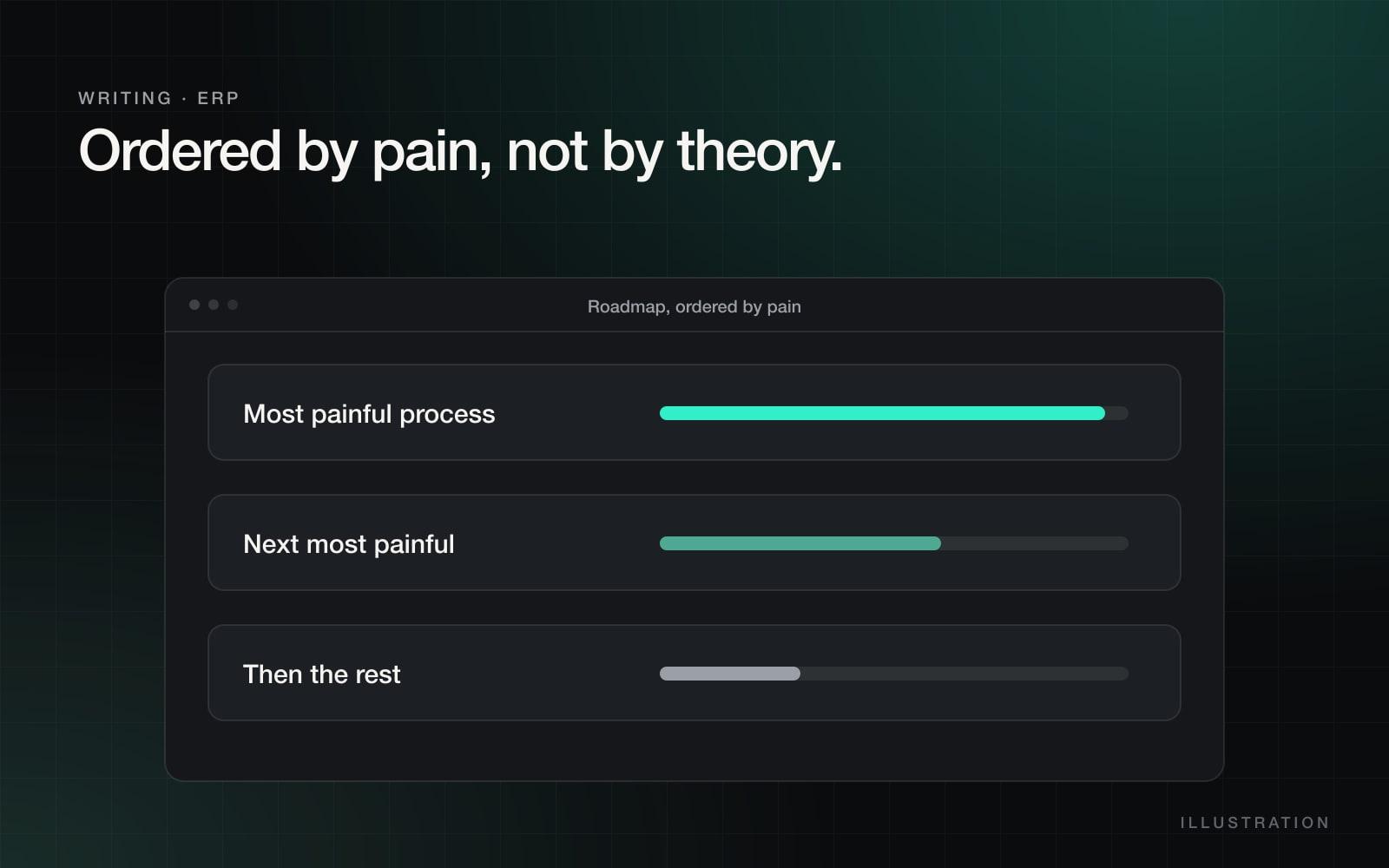
The decision is not custom versus packaged. It is whether the fit of your two or three unusual processes is worth building for. Usually you already know which those are, because they are the ones with the spreadsheets.
Thinking about a custom system instead of an off-the-shelf rollout? Here is how I approach it, or book a call and I will tell you honestly which way I would go.