UAE e-invoicing: what your ERP has to get right before your go-live date
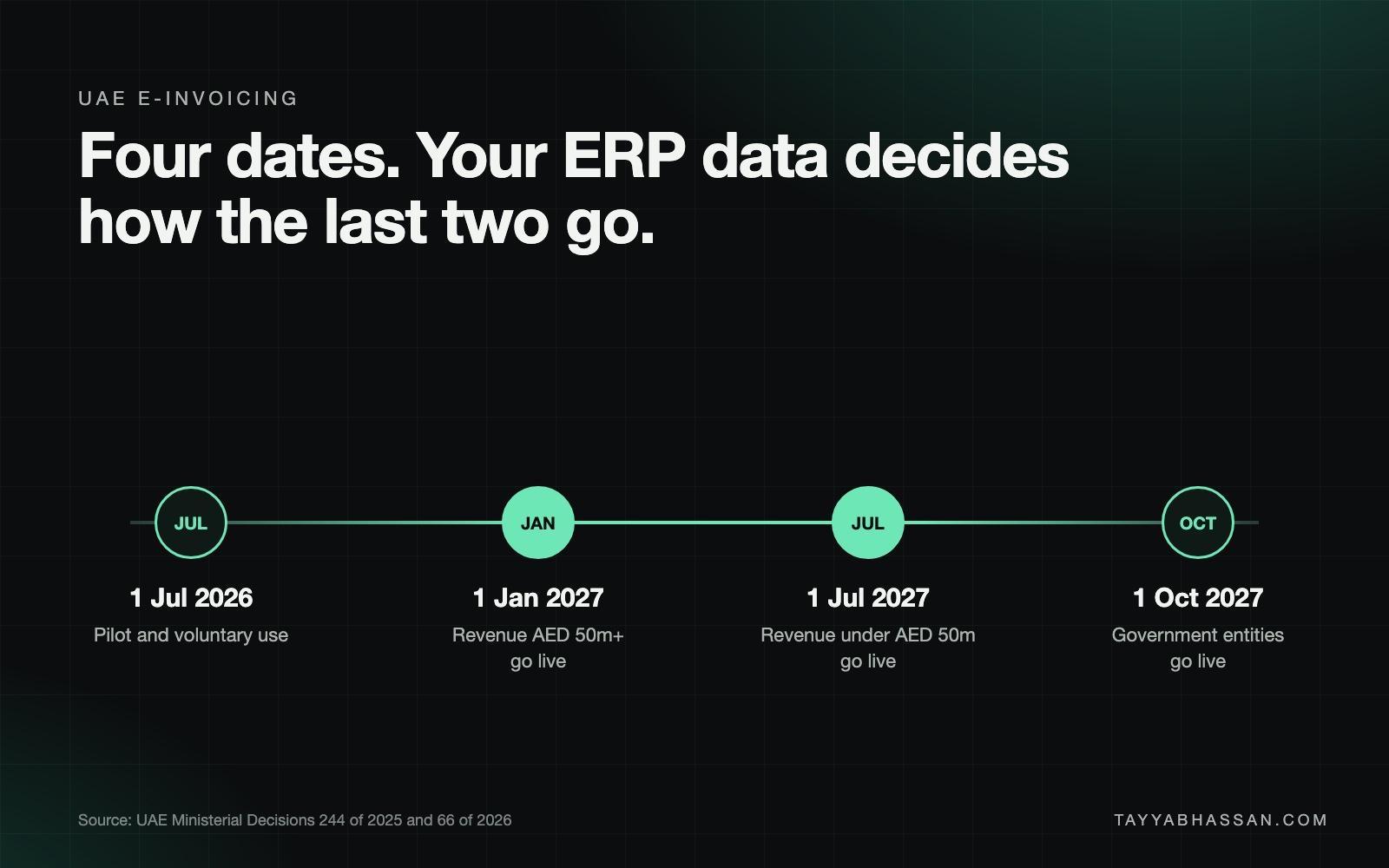
UAE e-invoicing starts on 1 January 2027 if your revenue is AED 50 million or more, and on 1 July 2027 if it is less. From your go-live date, every B2B and B2G invoice and credit note has to be issued as structured data, sent through an Accredited Service Provider, within 14 business days of the transaction. The provider handles the connection. Your ERP has to supply data that is complete and correct, and that is where most of the work is.
I build ERP systems for operations-heavy businesses, including one with 17 modules that 250 people use every day. This guide is not tax advice. It sets out what the official decisions say, then the parts of your ERP and your process that decide whether go-live is calm or painful.
The dates, from the official decisions
The timeline is set by Ministerial Decision No. 244 of 2025, and the large-business provider deadline was moved by Ministerial Decision No. 66 of 2026.
| Who | Appoint an Accredited Service Provider by | Go live by |
|---|---|---|
| Revenue of AED 50 million or more | 30 October 2026 | 1 January 2027 |
| Revenue under AED 50 million | 31 March 2027 | 1 July 2027 |
| Government entities | 31 March 2027 | 1 October 2027 |
"Revenue" here means gross income in your most recent accounting period, based on your financial statements. A pilot with selected businesses and voluntary adoption for anyone both started on 1 July 2026. Penalties do not apply to a business using the system voluntarily before its own mandatory date.
If you are in the first group and have not appointed a provider, the deadline has already passed. Talk to your tax advisor this week.
What actually changes
Today an invoice is a document. A PDF, a printout, an email attachment. From your go-live date, the invoice is the data itself, in a structured format a machine can read, and the PDF is just a picture of it.
In practice that means four things:
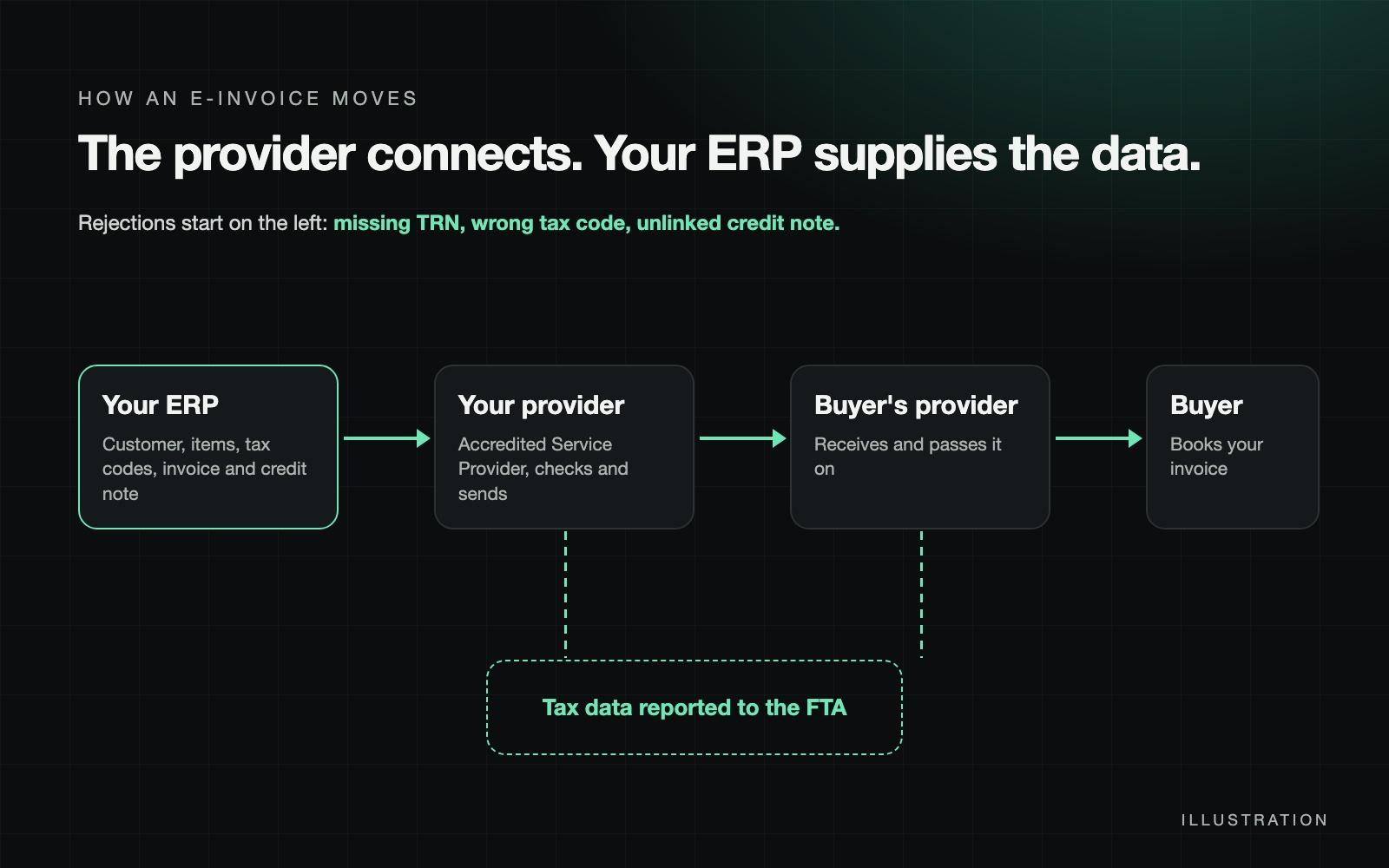
- Every invoice goes through your provider. You appoint an Accredited Service Provider from the Ministry of Finance list. Your ERP sends the invoice data to the provider, and the provider takes it from there.
- There is a clock. The e-invoice or e-credit note must be issued and transmitted within 14 business days of the transaction, under Ministerial Decision No. 197 of 2026.
- Credit notes count too. A return, a price correction or a cancelled order that you settle with a credit note has the same rules and the same clock.
- You keep the records. E-invoices, e-credit notes and their data have to be kept for the period in the Tax Procedures Law and produced if the Federal Tax Authority asks.
Who is in scope, and what is excluded
Business-to-business and business-to-government transactions are in scope. Business-to-consumer transactions are not, until the Minister sets a date by decision, and a business that only sells to consumers is outside the system for now.
Ministerial Decision No. 197 of 2026 also lists excluded transactions. The ones most likely to matter to a trading or services business:
- Transactions between members of the same VAT tax group, for 24 months from 1 January 2027.
- Financial services that are VAT-exempt or zero-rated.
- International air cargo where an airway bill is issued, for 24 months from the date the system becomes effective.
- Sovereign activities of government entities that do not compete with the private sector.
If you sell to both businesses and consumers, the B2B side is in scope. Your ERP needs to know which customer is which.
The penalties
Cabinet Decision No. 173 of 2026 sets the penalties and replaced Cabinet Decision No. 106 of 2025.
| Violation | Penalty |
|---|---|
| Not implementing the system, including not appointing a provider | AED 5,000, then AED 5,000 for each month it continues, capped at AED 50,000 in any 12 months |
| Not issuing and transmitting an e-invoice | AED 100 per invoice, capped at AED 5,000 a month |
| Not issuing and transmitting an e-credit note | AED 100 per credit note, capped at AED 5,000 a month |
| Not telling your provider about changes to your registered data | AED 250 a day, capped at AED 5,000 a month |
The amounts are capped, so for most businesses the bigger cost is not the fine. It is invoices stuck in rejection, customers who cannot book your invoice, and finance staff fixing records by hand at month end.
What your ERP has to get right
The connection to a provider is a project measured in weeks. Getting your data into shape is what takes the time, because the problems are spread across years of records. These are the areas I would check first.
Customer master data
Every business customer needs a correct legal name, address and Tax Registration Number, stored once, in one place. If your sales team keeps customers in a spreadsheet and finance keeps them in the accounting system, you have two versions and at least one is wrong. Fix the customer list before anything else.
Item and tax codes
Each product or service needs the right tax treatment attached to it, so the invoice carries it automatically. If someone picks the VAT rate by hand on each invoice, it will be wrong on some of them.
Invoices raised outside the ERP
Count the invoices that do not come out of your system. Word templates, Excel sheets, a branch that invoices from its own software. Every one of those is either moved into the ERP or connected to the provider separately. This is usually the biggest surprise in a readiness check.
Credit notes linked to their invoice
A credit note has to point back to the invoice it corrects. If returns and discounts are handled by email and a manual adjustment, there is nothing to link. Put credit notes in the same flow as invoices.
A queue for rejections
Some invoices will be rejected. Missing data, a wrong code, a closed customer account. Somebody has to see each rejection the same day and fix it inside the 14 business days. That needs a queue with an owner, not an inbox that three people half-watch.
Notifying your provider of changes
If your registered details change, your provider must be told, and the penalty for not doing so runs per day. Make it a step in the same process that updates your trade licence or TRN details, not something someone has to remember.
Check your store
How ready is your ERP for e-invoicing?
0 of 7 in place. Talk through the gaps on a call
Tick what is already true on your store. It runs in your browser and nothing is sent anywhere.
A plan if your go-live is 1 July 2027
If your revenue is under AED 50 million, you have until 31 March 2027 to appoint a provider. That is enough time to do this properly, if you start with the data rather than the connection.
- This month: list every place an invoice or credit note is created today, and who creates it.
- December: clean the customer master list and set tax treatment on every item.
- January: move invoices raised outside the ERP into it, and put credit notes in the same flow.
- February: choose a provider from the Ministry of Finance list, and agree how your ERP will send data to it.
- March: appoint the provider before the 31 March deadline, then test with real invoices.
- April to June: run in parallel, build the rejection queue, and train the people who own it.
The order matters. A provider connected to messy data gives you rejected invoices faster.
Sources
Everything above comes from the official texts published by the UAE Ministry of Finance. Check the current versions before you act, because the rules have already been amended twice in 2026.
- Ministerial Decision No. 244 of 2025 on the implementation of the e-invoicing system: phases, pilot, voluntary use and B2C.
- Ministerial Decision No. 66 of 2026: the 30 October 2026 provider deadline.
- Ministerial Decision No. 197 of 2026: exclusions, the 14 business day rule and record keeping.
- Cabinet Decision No. 173 of 2026: penalties.
- Ministry of Finance e-invoicing portal, including the list of Accredited Service Providers.
This guide explains what the rules require of your systems. It is not tax or legal advice. Confirm how they apply to your business with your tax advisor.
Where to start this week
Open your accounting system and count the invoices raised last month that did not come out of it. If the answer is more than zero, that is your first project.
If you want a second pair of eyes, I run a free 30-minute automation audit. Show me how invoices and credit notes are created today, and I will point out the gaps that will cause rejected invoices, and what to fix first.
Questions people ask
When does e-invoicing become mandatory in the UAE?
Businesses with revenue of AED 50 million or more must appoint an Accredited Service Provider by 30 October 2026 and go live by 1 January 2027. Businesses under AED 50 million must appoint one by 31 March 2027 and go live by 1 July 2027. Government entities appoint by 31 March 2027 and go live by 1 October 2027.
Does UAE e-invoicing apply to sales to consumers?
Not yet. Business-to-consumer transactions are outside the system until the Minister sets a date by decision, and a business that only sells to consumers is not subject to it for now. B2B and B2G transactions are in scope.
How long do I have to issue an e-invoice?
The e-invoice or e-credit note must be issued and transmitted through the system within 14 business days from the date of the business transaction, under Ministerial Decision No. 197 of 2026, in force from 1 October 2026.
What are the penalties for not implementing e-invoicing?
Under Cabinet Decision No. 173 of 2026, failing to implement the system or appoint an Accredited Service Provider costs AED 5,000, then AED 5,000 for each month it continues, capped at AED 50,000 in any 12 months. Each e-invoice or e-credit note not issued and transmitted costs AED 100, capped at AED 5,000 a month.
What is an Accredited Service Provider (ASP) for UAE e-invoicing?
A provider on the Ministry of Finance list that connects your invoices to the UAE e-invoicing system. You appoint one by your deadline. Your ERP supplies the invoice data and the provider transmits it.
Has the UAE e-invoicing deadline been extended?
The large-business provider deadline was moved to 30 October 2026 by Ministerial Decision No. 66 of 2026. As of 25 November 2026, the sources I checked report the 2027 go-live dates as unchanged. Check the Ministry of Finance portal for the current position before you rely on a date.
Does my ERP connect to the FTA directly?
No. You appoint an Accredited Service Provider, and the provider connects your invoices to the system. Your ERP has to produce complete, correct invoice data and hand it to the provider, and you remain responsible for that data.